 Skip to content



Madurasherbals
Polyquaternium-10
Couldn't load pickup availability
Product Description
INCI Name: Polyquaternium-10
Common Name: Polyquat-10
Chemical Nature: Cationic cellulose derivative
Origin: Cellulose-derived polymer, chemically modified with cationic groups
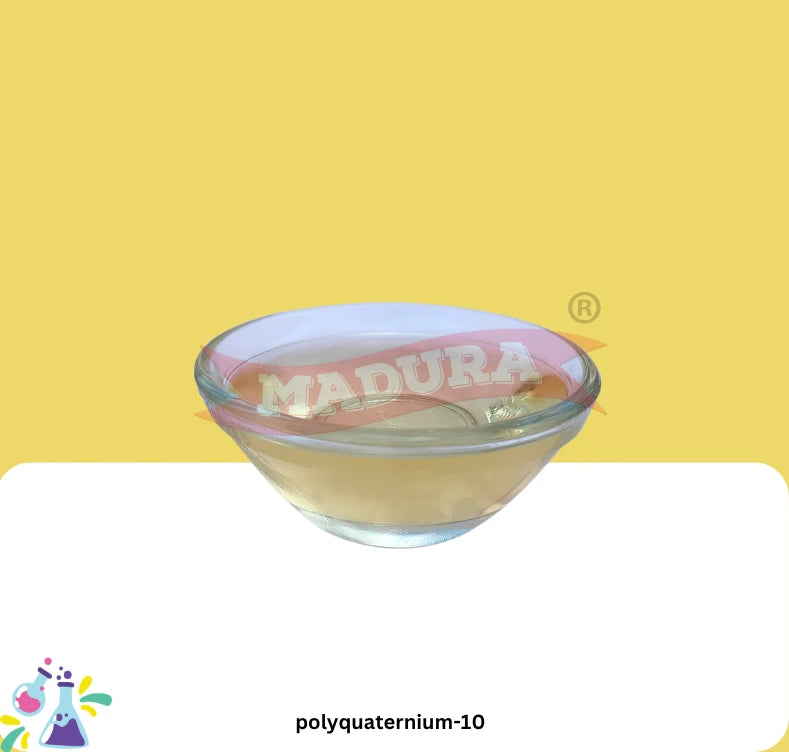
Appearance: White to off-white powder
Odour: Odourless or nearly odourless
Solubility: Water-soluble
Ionic Nature: Cationic
Function: Conditioning agent, anti-static agent, film former and viscosity modifier
Formulation Phase: Water phase
Application: Haircare, skincare and personal-care products
Polyquaternium-10, commonly known as Polyquat-10, is a cationic, water-soluble conditioning polymer derived from cellulose. It is widely used in haircare and personal-care formulations for its excellent conditioning, anti-static, film-forming and thickening properties.
It is particularly valued in shampoo and conditioner formulations for its ability to improve hair softness, smoothness, manageability and combability. Its positively charged polymer structure allows it to interact with the negatively charged surface of hair, helping form a lightweight conditioning layer that reduces friction and improves the overall feel of the hair.
Polyquaternium-10 also helps enhance the texture and sensory properties of cleansing products. It can improve the appearance, consistency and conditioning performance of shampoos, body washes and other surfactant-based formulations.
Due to its cellulose-derived backbone and excellent conditioning properties, Polyquaternium-10 is a popular ingredient in modern haircare products designed to provide smooth, soft and manageable hair.
Key Benefits and Properties
1. Excellent Hair Conditioning
Helps improve hair softness and smoothness by forming a thin conditioning film over the hair surface. It reduces friction between hair strands and improves overall manageability.
2. Anti-Static Properties
Helps minimise static electricity and flyaway hair, making hair easier to control and style.
3. Improved Wet and Dry Combing
Reduces friction during combing, helping improve both wet and dry hair manageability. It is particularly useful in shampoos designed for dry, tangled or difficult-to-comb hair.
4. Film-Forming Properties
Forms a lightweight conditioning film on the hair surface, helping improve smoothness and providing a pleasant after-feel.
5. Thickening and Viscosity Modification
Depending on the grade and formulation, Polyquaternium-10 can contribute to viscosity and improve the texture of surfactant-based products.
6. Improved Skin Feel
Can also be used in body washes and liquid cleansing products to provide a smoother, softer skin feel after washing.
7. Cellulose-Derived Polymer
It is produced by chemically modifying cellulose with cationic groups, making it useful for applications requiring both cellulose-based polymer characteristics and conditioning performance.
Applications in Cosmetics
Polyquaternium-10 is widely used in:
-
Shampoos and conditioning shampoos
-
Hair conditioners
-
Anti-frizz hair products
-
Hair detangling sprays
-
Leave-in conditioners
-
Hair masks and treatment products
-
Hair styling gels
-
Body washes and shower gels
-
Liquid hand washes
-
Facial cleansing products
-
Baby shampoos and mild cleansing products
-
Personal-care formulations
Recommended Usage Level
The recommended concentration depends on the grade, molecular weight, viscosity and desired conditioning performance.
Typical starting ranges:
-
Shampoo: 0.1–0.5%
-
Conditioning shampoo: 0.2–0.5%
-
Hair conditioner: 0.1–0.5%
-
Hair masks: 0.1–0.5%
-
Leave-in hair products: 0.1–0.3%
-
Hair detangling sprays: 0.1–0.3%
-
Body washes: 0.1–0.3%
-
Face washes: 0.05–0.2%
These are general formulation starting ranges. The optimum concentration should be determined through formulation trials.
Formulation Guidelines
Polyquaternium-10 is generally supplied as a fine white to off-white powder. Proper dispersion and hydration are important to obtain a smooth, lump-free formulation.
-
Slowly sprinkle Polyquaternium-10 into the water phase with continuous stirring.
-
Avoid adding the entire quantity at once, as this can cause lump formation.
-
Allow sufficient time for complete hydration.
-
Pre-dispersing the powder in glycerin can help reduce lump formation before adding it to water.
-
Depending on the grade, mild heating may help accelerate hydration.
-
Add surfactants gradually after the polymer has dispersed and hydrated adequately.
-
Avoid excessive agitation to minimise foam formation.
-
Allow the formulation to equilibrate before evaluating its final viscosity and appearance.
Polyquaternium-10 is particularly useful in shampoos containing anionic surfactants. During dilution, certain surfactant systems can form coacervates with the cationic polymer, helping improve conditioning-agent deposition on the hair.
Storage and Handling
-
Store in a tightly sealed original container.
-
Keep in a cool, dry and well-ventilated place.
-
Protect from moisture and excessive humidity.
-
Avoid direct sunlight and excessive heat.
-
Keep the container closed when not in use.
-
Prevent contamination during handling.
-
Refer to the supplier's technical data sheet for specific storage conditions and shelf life.
Frequently Asked Questions
1. What is Polyquaternium-10 used for in cosmetics?
Polyquaternium-10 is primarily used as a conditioning, anti-static and film-forming agent. It is commonly incorporated into shampoos, conditioners, hair masks and cleansing products to improve softness, smoothness and manageability.
2. Is Polyquaternium-10 good for shampoo formulations?
Yes. It is widely used in shampoo formulations to improve conditioning, reduce hair friction and enhance wet combability. It helps leave hair feeling softer and smoother after washing.
3. Is Polyquaternium-10 water-soluble?
Yes. Polyquaternium-10 is water-soluble. It should be properly dispersed and hydrated in water before incorporating other formulation ingredients.
4. Can Polyquaternium-10 be used with CAPB and Coco Glucoside?
Yes. It can be incorporated into formulations containing Cocamidopropyl Betaine (CAPB) and Coco Glucoside. However, the compatibility and final viscosity should be evaluated through formulation trials.
5. Can Polyquaternium-10 increase shampoo thickness?
Yes. Depending on its grade and concentration, it can contribute to viscosity and improve the texture of shampoo formulations. However, its primary function is conditioning rather than acting as a dedicated thickener.
6. What is the difference between Polyquaternium-7 and Polyquaternium-10?
Polyquaternium-7 is a synthetic cationic copolymer generally supplied as a liquid solution, whereas Polyquaternium-10 is a cationic cellulose-derived polymer generally supplied as a powder. Both provide conditioning and anti-static benefits, but they differ in hydration requirements, formulation behaviour and sensory performance.
7. Can Polyquaternium-10 be used in sulphate-free shampoos?
Yes. It can be used in sulphate-free formulations containing surfactants such as CAPB, Coco Glucoside and other compatible cleansing agents. The final formulation should be tested for clarity, viscosity and conditioning performance.
8. Is Polyquaternium-10 a natural ingredient?
Polyquaternium-10 is derived from cellulose, a plant-based raw material, but it undergoes chemical modification to introduce cationic groups. Therefore, it is more accurately described as a cellulose-derived modified polymer rather than a 100% natural ingredient.
Why Choose Polyquaternium-10?
Polyquaternium-10 is a versatile conditioning polymer that helps formulators develop high-quality shampoos, conditioners and personal-care products. Its excellent conditioning, anti-static, film-forming and cellulose-derived properties make it a valuable ingredient for creating smooth, soft and manageable haircare formulations.

Disclaimer
All information on this website is for educational and reference purposes only and does not constitute medical, professional, legal, or technical advice.
Intended Use
Our products are raw materials and ingredients supplied for cosmetic formulation, personal care, manufacturing, aromatherapy, candlemaking, soap making, food and beverage, confectionery, research, and related industries. Suitability for any specific application is the buyer's responsibility.
Natural & Batch Variation
Natural variations in colour, aroma, texture, viscosity, and potency may occur between batches, as this is characteristic of natural and plant-derived ingredients and does not indicate a quality defect.
For formulated and processed products, including chemicals, waxes, bases, butters, and extracts, variations in performance or specification may also occur between batches.
For colouring agents and food colours, variations in shade, intensity, particle size, dispersion, and thickness may occur between batches due to sourcing or processing differences. For flavor oils, variations in colour, taste profile, and aromatic strength may occur between batches.
Equipment & Kits
Equipment, accessories, moulds, containers, and kits are utility and starter-level items with no performance warranty. Product images, kit contents, and item brands or models may vary based on stock availability.
Safety & Internal Use
Essential oils, aroma compounds, flavor oils, concentrated extracts, and chemicals must be handled responsibly and diluted appropriately. Products intended for internal use, including herbal powders, Ayurvedic botanicals, and food-grade ingredients, should be used under the guidance of a qualified healthcare, Ayurvedic, or food safety practitioner.
Testing, Samples & Lab Reports
Customers are responsible for testing suitability within their own formulation and intended application before placing bulk orders. Samples are at your own cost, and free samples may be available subject to stock and product type. Sample size and quantity are at our discretion, and shipping charges apply. Laboratory test reports can be arranged on request at an additional cost.
Representative Documents: COA & MSDS
The COA and MSDS linked on product pages are representative documents shared for reference purposes only and may not reflect the exact batch supplied for your order.
Batch-specific documents can be requested before or at the time of purchase. It is the customer's responsibility to verify that specifications meet their intended use before purchasing in bulk.
B2B Terms
All transactions on this website are B2B in nature. By purchasing from us, you agree to our Terms & Conditions, Privacy Policy, Shipping Policy, and Refund Policy.